The answer depends on the type of spa you’re installing — but for most hardwired hot tubs and swim spas, the answer is yes to both. Here’s what Texas homeowners need to know before installation day.
So you’ve found your dream swim spa or hot tub. The backyard is ready, the excitement is real, and you’re itching to get the water warm. But before any of that happens, there’s an important question every Texas homeowner needs to answer: do you need a permit, and does the electrical work have to be done by a licensed electrician?
For most hot tubs and swim spas, particularly the hardwired 220V-240V units, the answer to both is yes. And skipping either one can lead to serious consequences: safety risks, failed home inspections, denied insurance claims, voided warranties, and fines that take the shine off a perfectly good investment. Let’s walk through what you actually need to know.
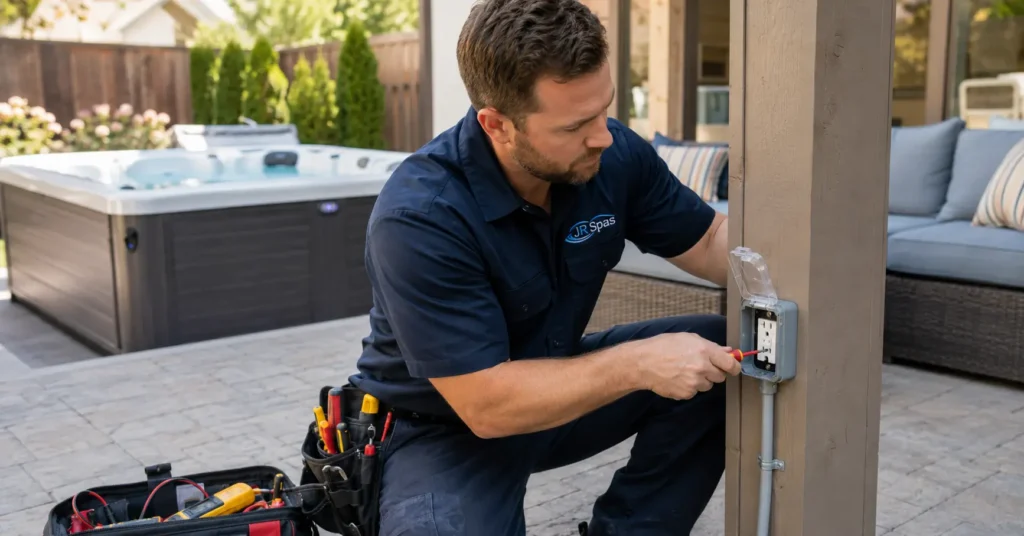
Do you need a permit to install a hot tub or swim spa in Texas?
It depends on the type of hot tub and what county or city you’re in, but for most permanent installations, yes. Here’s the practical breakdown:
Plug-and-play hot tubs (110V)
Portable, plug-and-play hot tubs that run on standard 110V power typically don’t require a building permit in most Texas cities. They operate on a regular household outlet and don’t require new wiring. That said, if you’re building a new deck or pouring a concrete pad to accommodate one, a building permit for that construction work may still be required.
Hardwired hot tubs and swim spas (220V–240V)
This is where permits become non-negotiable. Most hot tubs and virtually all swim spas run on 220V-240V power and require a dedicated hardwired circuit. In Texas, this type of installation nearly always requires:
- An electrical permit is required for any new 220V wiring, and the work must be done by a licensed electrician.
- A building or site permit is typically required for in-ground or permanent installations, and for any new deck or concrete pad construction.
- HOA approval if your neighborhood has a homeowner’s association. HOAs often have separate requirements that are stricter than city code.
Permit requirements are set at the local level, so the specifics vary by city. Some areas require a notarized affidavit, specific scaled drawings, and separate electrical and plumbing permit validations.
Review Granbury’s building inspections, permits, and codes, or contact JR Spas to help you understand what’s needed for your property.
| Community | Situation | What to do |
| Acton, DeCordova | Unincorporated, Hood County | Contact Hood County Development Services |
| Tolar | Small city, Hood County | Call Tolar City Hall (254-835-4390) |
| Godley | Small city, Johnson County | Contact Godley City Hall or Johnson County Development Services |
| Pecan Plantation, Canyon Creek, Oak Trail Shores | POA-governed communities | Review deed restrictions with your POA before anything else |
What types of permits might you need for a hot tub or swim spa in Texas?
Most homeowners hear “you’ll need a permit” and assume it’s a single form and a filing fee. In reality, this process can involve several different types of permits and approvals depending on the scope of the project. Here’s a breakdown of what each one covers and when it typically applies.
Electrical permit
This is the one that applies to almost every hardwired hot tub or swim spa installation. Any time a new 240V dedicated circuit is being added to your home, which is required for virtually all full-size hot tubs and swim spas, an electrical permit is required. In Texas, this permit is typically pulled by your licensed electrician as part of the job, and an inspection will be scheduled to verify the work before the circuit is energized. If an electrician offers to skip this step, that’s a serious red flag.
HOA or POA architectural approval
Technically not a government permit, but often the first gate a homeowner needs to clear. If you live in a neighborhood governed by a homeowners association or property owners association, their deed restrictions and architectural guidelines may place requirements on your installation that go beyond what your city or county requires. This can include rules about screening, setbacks, unit dimensions, or even whether a spa is permitted at all.
It’s worth noting that HOAs sometimes misclassify swim spas as above-ground pools, which can trigger a denial based on rules that weren’t actually written with swim spas in mind. If you run into this, the distinction matters — a swim spa is a self-contained, portable unit, not a pool — and documentation from the manufacturer or dealer can help make that case to your HOA board.
Building or structural permit
A building permit is generally required when the installation involves construction work beyond the spa itself. This includes pouring a new concrete pad, building or modifying a deck, making structural changes to accommodate the unit, or installing an in-ground or partially recessed spa. For a prefabricated hot tub or swim spa sitting on an existing, adequately reinforced surface, a building permit may not be required, but this varies by city and county, so it’s always worth confirming before work begins.
Notarized affidavit
Some Texas municipalities require a signed and notarized affidavit as part of the permit application — a formal statement from the homeowner confirming the installation details and acknowledging compliance responsibilities. This isn’t a permit itself, but a missing affidavit can hold up your permit approval. It’s the kind of paperwork that catches homeowners off guard, especially when coordinating multiple contractors independently.
A good rule of thumb: before any work begins, confirm with your local building department which permits apply to your specific project, and check with your HOA or POA if applicable. The JR Spas team is familiar with Hood County and the surrounding area and is happy to help you think through what your property may require.
The table below gives a quick-reference summary of when each permit type most commonly applies:
| Permit/Approval | When It Typically Applies | Required? |
| Electrical permit | Any new 240V hardwired circuit | Almost always |
| Building/structural permit | New concrete pad, deck, or in-ground installation | Depends on scope |
| Notarized affidavit | Required by some Texas cities as part of permit app | City-dependent |
| HOA/POA approval | Any deed-restricted community | Check here first |
What if you skip the permit and do the work yourself?
Unpermitted work doesn’t just put you at risk today — it can result in fines, a requirement to remove or redo the installation at your own expense, denied insurance claims, and complications when selling your home, since unpermitted work almost always surfaces during a real estate inspection. It’s not worth the shortcut.
Does a hot tub installation require a licensed electrician in Texas?
Yes — and this is one area where cutting corners can be genuinely dangerous. Hot tubs and swim spas combine high-voltage electricity with water, which makes proper wiring not just a code requirement but a matter of life and safety. North Texas follows the National Electrical Code (NEC), which sets strict requirements for spa and hot tub installations under Article 680.
What the NEC requires for hot tub electrical installations
Regardless of which Texas city you’re in, any hot tub or swim spa installation must comply with NEC Article 680. Here are the key requirements every homeowner should understand:
- A dedicated 240V circuit — most hot tubs require a dedicated 240-volt circuit rated between 40 and 60 amps, separate from any other circuits in your home.
- GFCI protection — a Ground Fault Circuit Interrupter (GFCI) is mandatory on all spa circuits. This is the device that cuts power instantly if it detects a ground fault, protecting anyone in or near the water from electrocution.
- A manual disconnect switch — required to be installed between your main panel and the spa, positioned at least 5 feet from the tub but within line of sight, so power can be cut quickly in an emergency.
- Proper bonding and grounding — all metal components within 5 feet of the water must be bonded together using a solid copper conductor (8 AWG minimum) to prevent dangerous voltage differences.
- Conduit and burial depth — for underground runs, NEC requires conduit to be buried at least 18 inches deep.
- 4-wire service — any spa built in the last 25 years requires a 4-wire installation (two hot wires, one neutral, one ground). The older 3-wire method is no longer code-compliant for new installations.
Research suggests that around half of all hot tubs installed in the U.S. have some type of electrical or plumbing code violation — even when installed by professionals. This is largely because spa technicians specialize in hot tub hardware, not electrical systems. It’s a compelling reason to make sure your hot tub electrician is licensed and code-savvy, not just experienced with spas.
What about your home’s electrical panel?
Before a new circuit can be added, a licensed electrician will assess whether your existing panel has the capacity to handle the additional load. Most homes built in the last 30 to 40 years have at least 100-amp service, which is generally adequate, but if your home has an older panel or is already running close to capacity, an upgrade may be necessary. Some cities in North Texas, including Keller, actually require a formal load calculation to be submitted with the permit application if your home has less than 200-amp service.
This is exactly the kind of detail that gets missed when homeowners try to coordinate electrical work independently — and exactly the kind of thing our licensed electricians at JR Spas catch before it becomes a problem.
Are hot tub electricians part of a typical dealer team?
No, but at JR Spas, we do things differently. Our team includes licensed electricians, which means the people who sell you your spa are the same people who understand exactly what it takes to install it correctly and safely. There’s no disconnect between the sales experience and the installation reality. We assess your property, pull permits, and do the work right — the first time.
Most hot tub and swim spa dealers expect you to figure out how to get your home ready long before delivery. You’re the one who needs to find your own electrician, coordinate schedules, and hope everything gets done to code. That’s a lot of moving parts — and a lot of room for things to go sideways.
When you buy a swim spa or hot tub from JR Spas, you’re not just buying a product. You’re buying confidence that every part of the process, from site preparation to final electrical hookup, is handled by professionals who are accountable to you and familiar with local Texas codes.
Frequently Asked Questions About Hot Tub Electrical Requirements
Can I do the electrical work myself when installing a hot tub in Texas?
In many Texas jurisdictions, hot tub electrical work must be performed by a licensed electrician. You may be able to apply for a homeowner permit, but the complexity and safety stakes of installing a new 240V GFCI circuit make DIY electrical work a serious risk. We always recommend working with a licensed professional.
What happens if a hot tub is installed without a permit in Texas?
Installing a hot tub without the required permits may result in fines from your municipality, a requirement to remove or bring the installation into compliance at your own expense, complications during a home sale (unpermitted work typically surfaces during inspection), and potential voiding of your spa manufacturer’s warranty.
How long does it take to get a hot tub electrical permit in Texas?
Processing times vary by city, but most North Texas municipalities take three to five business days to issue a permit once a complete application is submitted.
Does JR Spas handle permits and electrical installation?
Yes. JR Spas has licensed electricians on our team and can handle electrical installation or even repairs. We also provide site preparation as part of our installation services, including ground leveling, gravel bases, and concrete pad pouring, meaning you won’t need to manage multiple contractors.
Call (817) 579-7727, request a free quote, or visit us in person at 4500 Fall Creek Hwy, Granbury, TX 76049.